
Union County Tax Record Fields
Union County property tax records split their fields across several linked sources. The WTH property card holds land, improvement, and total value history. The Auditor manages deductions and the tax roll. Bill and payment context comes from the Treasurer and the state Gateway portal, so a full parcel picture may take more than one lookup.
| Field | What It Shows | Where |
|---|---|---|
| Land value | Assessed land component | WTH card |
| Improvement value | Assessed building component | WTH card |
| Gross / net assessed value | Value before and after deductions | Assessor and Auditor |
| Tax bill and status | Amount billed, paid, or due | Treasurer and Gateway |
| Tax district | Local rate context | Card and bill |
Indiana assesses property at a market-value-in-use standard with a 100 percent assessment level. That figure is not a forecast of what a sale would bring today. Deductions lower the net taxable value. They leave the gross assessed value untouched. From there, rates, credits, and circuit-breaker rules shape the final tax bill in Union County.
Search Union County Gateway Fields
The Indiana Gateway Tax Bill Lookup asks only for Pay Year and County. Optional filters include Taxing District or Unit, Taxpayer Name, Address, Parcel Number, a district-rate range, a total-bill range, and sorting. For a Union County property search, partial street wording or a reversed name order sometimes returns better results.
| Gateway control | Requirement | Use |
|---|---|---|
| Pay Year | Required | Select the bill year |
| County | Required | Select Union County |
| Taxpayer / Address / Parcel | Optional | Identify the record |
| District or Unit | Optional | Narrow taxing geography |
| Rate / Total Bill | Optional ranges | Narrow amounts |
The Gateway interface is shown below.
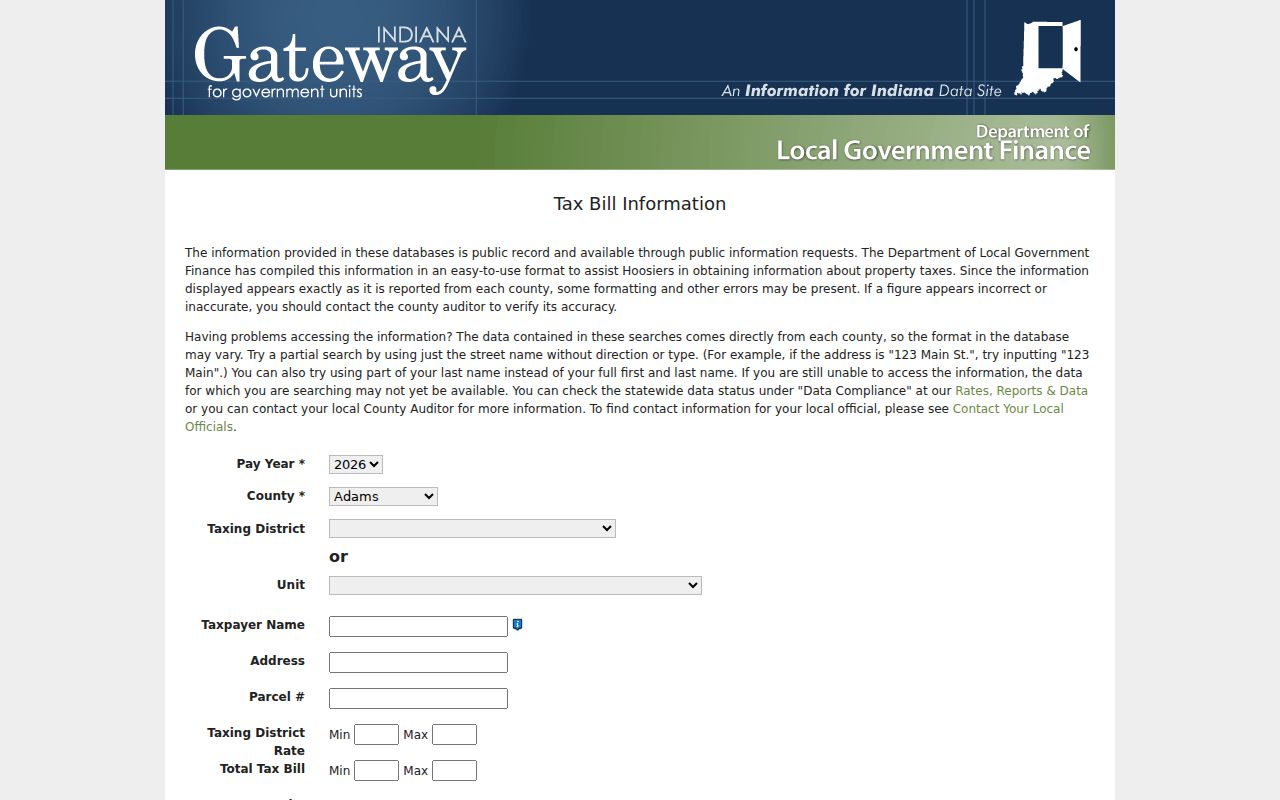
The official Gateway page displays the filter set described above. Gateway itself notes that its figures come from county reports and that coverage varies by pay year in Union County.
Union County Tax Office Roles
Three offices answer three different questions in Union County. The Assessor certifies land and building values and points users to the WTH property cards. The Auditor handles deductions, tax-roll administration, and public-record routing. It routes you when you are unsure where a record lives. The Treasurer collects and invests county funds and manages bills, payments, penalties, and tax-sale exposure.
The Treasurer sits at 26 W Union Street. It is open weekdays from 8 a.m. to 4 p.m. The office phone is `(765) 458-6491`, though it is not the payment line. Mail goes to PO Box 133, Liberty, IN 47353. A north-door drop box at ground level takes checks and coupons around the clock.
When you request a record, include the APN, owner or taxpayer name, property address, pay year, and the document you need. Indiana APRA requires reasonable particularity for an existing record. It does not obligate the county to build a new report. Nor must it run extensive research for you.
Union County's Current Tax Calendar
For 2025 pay 2026, the Treasurer lists May 11, 2026 as the spring due date. November 10, 2026 is the fall due date. These are operational dates, so recheck them before paying. Also remember that assessment year and payable year are not the same thing.
Online and card payments run through AllPaid. The published processing charge is 2.95 percent with a $3.99 minimum. A live-agent phone payment adds $3.50. Checks and coupons can travel by mail or the north-door drop box. Confirm any changed fee on the Treasurer page before you submit payment.
Partial payments do not erase penalties or tax-sale exposure in Union County. A delinquent bill is a tax status, nothing more. It does not prove a sale happened or that title passed. So check the Recorder, Treasurer, Auditor, and any court file for later steps. Note: Keep a receipt and pay-year label with every payment record.
Look Up Union County Tax Bills
A Union County bill search works best with the parcel number from WTH. An address or taxpayer name can start the lookup. The APN then separates similar names and road variants. Set the right pay year and county before reading any amounts.
- Select Pay Year and Union County in Gateway.
- Search by APN, address, or taxpayer name.
- Compare the bill with WTH value and Auditor deduction records.
- Ask the Treasurer to confirm payments, penalties, or sale exposure.
- Assessed value
- The value assigned in the property-tax system.
- Tax rate or levy
- The rate framework applied within the taxing district.
- Homestead deduction
- A qualifying deduction that can reduce net assessed value.
- Tax lien
- A public claim connected to unpaid property tax.
Never infer ownership from the taxpayer label alone. The Assessor roll may lag behind a recent deed, and mailing data can differ from the situs. When title matters, confirm the owner of record through the Union County Recorder.
Union County Values in WTH
The WTH property card shows annual assessment rows. It lists land, improvement, and total values. Transfer and parcel data appear as well. The card labels its values as work in progress and non-certified. It does not state its earliest year of online coverage.
Indiana's cyclical reassessment program reviews about 25 percent of property each year. The cycle runs over four years. A value change can stem from reassessment. New construction, a parcel change, a data correction, or another tax event can also shift it. Before claiming a Union County property rose or fell, compare the same value type across the same year.
Treat assessor transfer rows with care too. One sample shows a 1900 zero-dollar legacy entry. That is not a normal sale. Recorded deeds and real sale consideration sit apart from assessed value. The Union County home value page covers what a valuation means in more depth.
Union County Deductions and Net Value
Deductions lower the net value behind a Union County tax bill once statutory rules are met. The Auditor holds the answer. The deduction on a parcel belongs in the Auditor's deduction record and the tax record, not in guesses drawn from an owner's name or mailing address. Homestead data can hint at a claim. It proves neither occupancy nor title.
Start with the WTH card and the bill, then ask the Auditor which deduction record and filing route applies. Preserve both the assessment year and the effective year. That distinction matters. A deduction can shift the bill even when gross land and improvement values hold steady. When a deduction seems missing, separate two questions. Correcting objective tax data follows one route and appealing the parcel's value follows another, and DLGF describes both; bring the parcel number, notices, bill, and supporting papers to the right Union County office.
Union County Delinquency Limits
A delinquent Union County tax record shows an unpaid amount or a related status on a given day. It proves no sale, no confirmation, and no deed. The Treasurer adds that partial payment removes neither penalties nor exposure.
Build the full trail instead. Ask the Treasurer or Auditor about the sale stage. Request the ledger detail too. Search the Recorder for any tax-related instrument, and check MyCase or Clerk files when a dispute reached court, matching every step by parcel, owner, date, and legal description. This layering ends a common myth. A delinquent bill is not a deed. A GIS owner line is not a title opinion, and a parcel outline is not a survey; every record speaks only for the system that created it.
Reconcile Union County Tax Years
A sound Union County property tax search labels every number with its year and its source. The assessment year describes valuation. The pay year identifies the bill. Recording and sale dates sit on other timelines, so unlabeled amounts can suggest a trend that never existed. Start with the WTH land, improvement, and total rows. Open Gateway for the chosen Pay Year and compare taxpayer, address, APN, district, and amount. The Auditor can explain deductions. The Treasurer covers payment status. Save Form 11 whenever the value changes, because work-in-progress card figures can move and Gateway copies them from county reports the ledger outranks. Date each capture, keep receipts, and when figures disagree, decide whether year, gross versus net value, a deduction, a correction, a posting, or the parcel explains the difference.
Keep the original notice, bill, parcel card, and every county reply in one labeled file. That set tells the story. It shows which office supplied a figure. It shows when it applied, and whether a later correction or payment changed the result. In an informal assessor meeting or a formal review, a dated Union County file beats a screenshot. A screenshot with no year does not compare.
Appeal Union County Assessments
DLGF's Form 11 is the notice of assessment, and Form 130 opens a property-tax assessment appeal. The path starts locally. File with the Union County Assessor first, and the case may then move through the Property Tax Assessment Board of Appeals, the Indiana Board of Tax Review, and the Indiana Tax Court.
The date printed on the notice controls. Confirm it with the Assessor. Evidence should target the disputed value. Objective errors deserve different proof, and useful material ranges from comparable sales and photographs to measurements, a recent appraisal, deed or sale evidence, and proof of a data error. Keep copies of everything. Label the parcel and tax year throughout, and use the DLGF appeal route page, which separates valuation appeals from data corrections and posts the current forms.
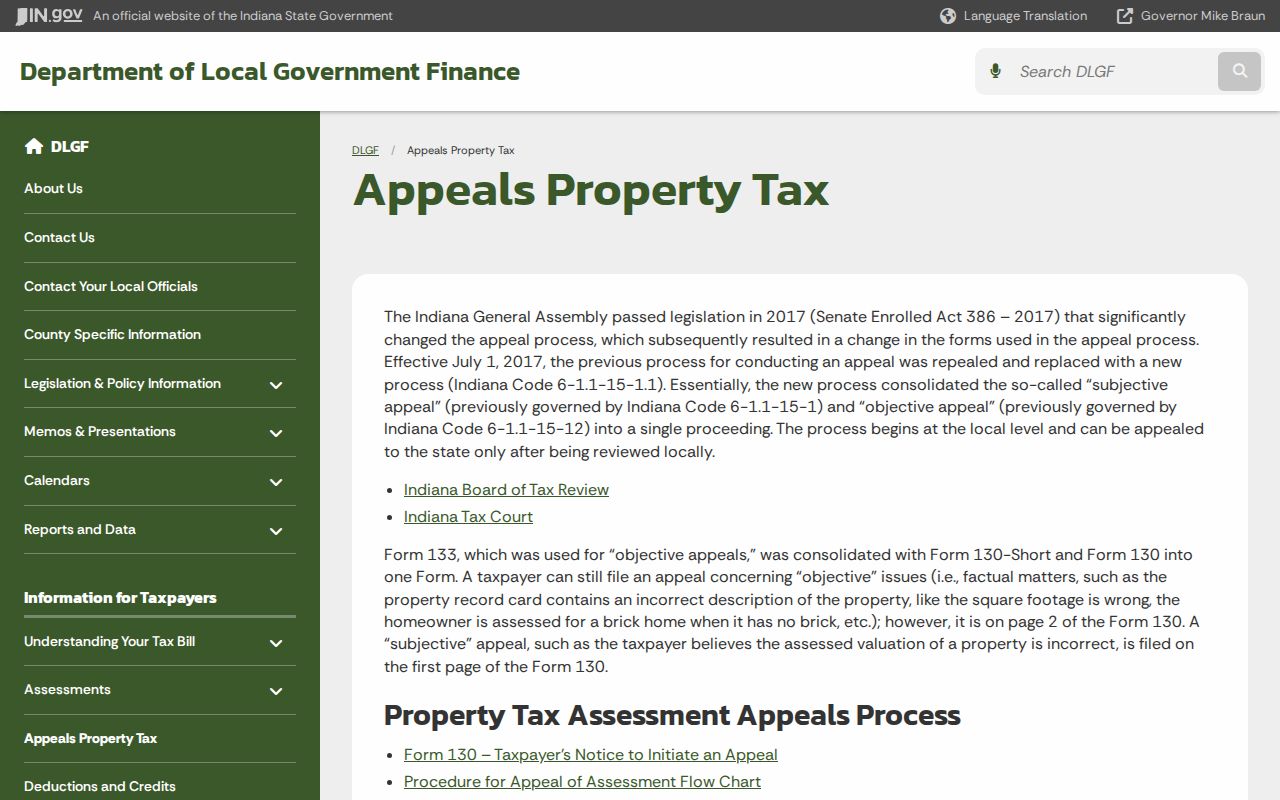
The state page distinguishes valuation appeals from correction of objective errors. It also points to the current forms.
Appeal window. Read the current Form 11 and contact the Union County Assessor promptly. No fixed local deadline should be substituted for the notice governing the parcel.
The Form 11 guidance is also preserved in the following capture.
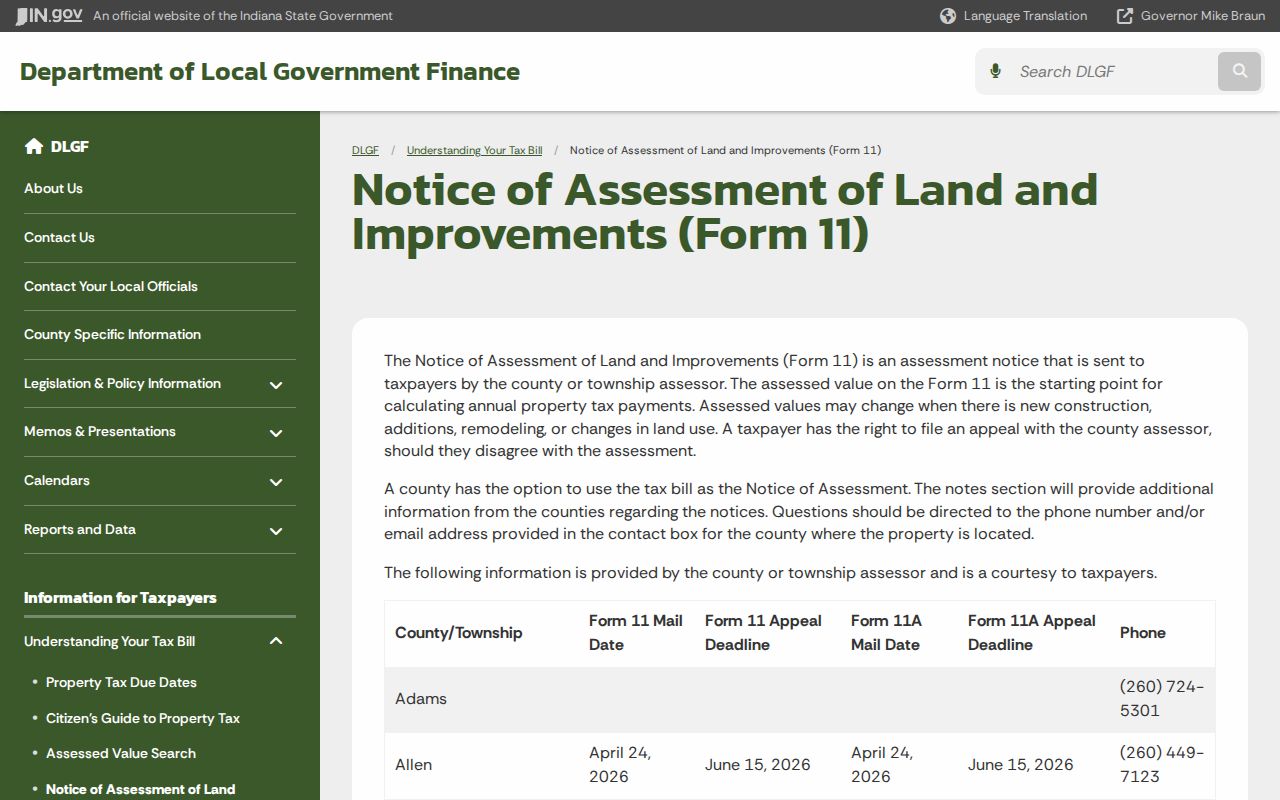
Form 11 remains the practical place to confirm how an assessment and its filing date apply to one parcel. Check your own notice.