
Build a Union County Prior-Owner Timeline
Start with the newest recorded deed and log every transfer in its own row. The Union County Recorder keeps the grantor and grantee instruments that anchor the chain. Transfer rows in the WTH GIS property search can offer leads. They never replace the recorded images. Exact dates, names, deed type, and a recording reference make the whole sequence auditable later.
| Transfer date | Grantor to grantee | Deed type | Reference |
|---|---|---|---|
| Newest first | Current deed's grantor to present grantee | As indexed | Document number and legal description |
| Next older | Prior owner's seller to that prior owner | As indexed | Document number or book/page |
| Book era | Names from deed books and reverse index | As recorded | Book, page, tract, lot, or section |
| Map cross-check | Historic owner label, not a conveyance | Not applicable | Map title, year, township, and page |
One sample WTH card lists transfers from 2024, 2020, 2013, and 2010, plus a January 1, 1900 zero-dollar sentinel. Treat the real rows as clues only. Confirm each document through the Recorder before it enters your timeline.
The Union County Online Deed Cutoff Is Not One Date
The Recorder page advertises Doxpop remote public access covering 1998 to current. The Doxpop county roster lists Union County from June 1987. The two dates do not tell the same story. Records from 1987 through 1997 may be indexed remotely without every image being viewable. So treat the earlier year as an index or partner-coverage clue rather than a guarantee. Ask the Recorder directly whether the year you need is an online index, an online image, a courthouse-only image, or a paper or microfilm book. Public computers sit at 26 W Union Street. Hours are Monday through Friday, 8 a.m. to 4 p.m., closed noon to 1 p.m. Staff will not run the search or hand out legal opinions, so bring your own parcel number and plan.
Coverage limit. Do not promise a single web cutoff. Confirm the index and image depth with the Union County Recorder before ending a chain.
Water Damage After Union County's 1903 Fire
The Indiana State Library county guide notes an 1903 courthouse fire. Water damage affected some records. A thin page, faint entry, or early gap can reflect preservation trouble. That is not proof a deed never existed. Search grantor and grantee forms. Check neighboring book pages, plat names, and related court files too. Note in your log what was readable and what was not. Then hunt duplicates in an abstract, a later deed recital, a mortgage, a release, a probate file, a landowner map, or a newspaper. Never invent a missing transfer just to make the deed records look complete.
Union County Owner Maps Reach Before Parcel Cards
The State Library map inventory holds 1855 and 1867 owner maps, Hixson and Sidwell township maps, and later plat books through 2023. An old plat can pair a former owner's name with a road, a township, or an adjoining owner. The digitized Hixson/Sidwell item puts the whole township sequence a click away.
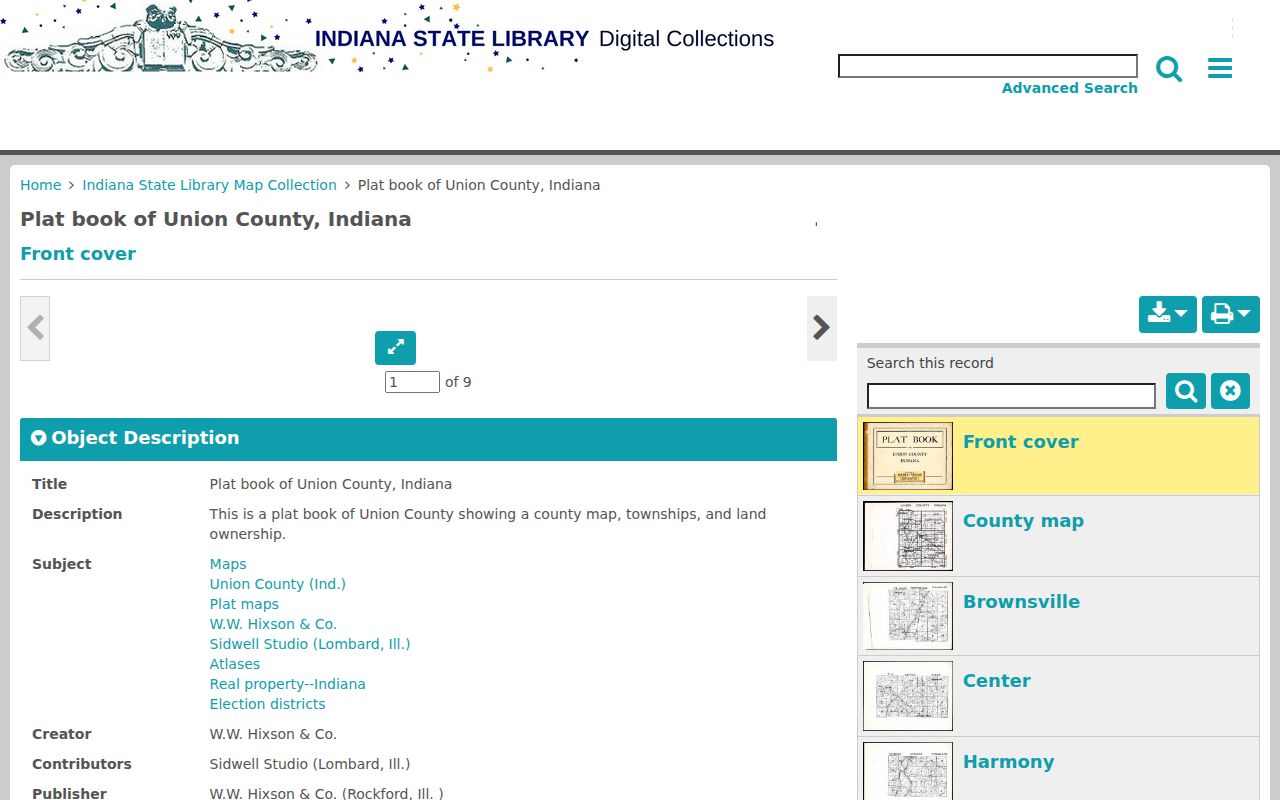
A map label is supporting evidence, never a deed. Match it against legal descriptions, recorded plats, and later conveyances in the Union County property records.
Walk Union County's Deed Chain in Reverse
The backward method follows people through their acquisition deeds while rechecking the land description at every step. Names alone are weak glue. Spouses, estates, entities, and same-surname neighbors can all create false joins in a Union County parcel chain.
- Find the present owner's acquisition deed with that owner as grantee.
- Record the grantor, date, legal description, deed type, and reference.
- Search that grantor as grantee to locate how the prior owner acquired the same land.
- Repeat until the web index ends, then continue through the courthouse reverse index and deed books.
- Grantor and grantee
- The conveying and receiving parties named in a deed.
- Chain of title
- The ordered sequence of instruments affecting the same land.
- Reverse index
- An index used to find how a named grantee acquired property.
- Quitclaim and warranty
- Different deed forms that must be reported as indexed, without assuming the quality of title.
- Legal description
- The tract, section, lot, block, or metes-and-bounds wording that keeps the chain on the same land.
Probate Can Explain a Union County Chain Break
An estate transfer rarely looks like an ordinary sale. Search the Indiana MyCase portal for a probate, partition, foreclosure, or quiet-title matter. Then request the official file from the Union County Clerk. Return to the Recorder for any personal representative's deed, sheriff's deed, or other recorded instrument. A tax delinquency or open court case does not prove a former owner lost title. The recorded deed and court order must match the subject legal description. Only then is anything settled.
Put Former Union County Owners Back in Place
Once the deed chain is documented, newspapers and maps can add real color. They can show how a prior owner used or changed the land. The Union County Times digital archive spans 1934 through 2002 with 33,514 pages. Hoosier State Chronicles offers another free historical newspaper route. Pair a former owner's name with a road, township, business, probate notice, or property description when you search. Each article is context, not a conveyance. For house history the pairing works well. It joins recorded land identity with dated local events from Union County property records. Note: Keep newspaper dates and map citations in a separate evidence column so they never masquerade as deed transfers.
Old Union County Addresses Need Legal Descriptions
Street names, route abbreviations, postal cities, and even parcel numbers can change. The tract stays recognizable in a deed. Search both current and older road wording. Then compare section, township, range, lot, block, subdivision, or metes-and-bounds text. Keep going until the land identity locks. The Recorder and Surveyor settle that identity. A historic directory or newspaper address is only a lead. Near West College Corner, confirm the state and county first. An Ohio address may share the College Corner name. Yet it can belong to a different recorder and parcel system.
Courthouse, Library, and Archive Routes for Prior Owners
When Doxpop stops, the Union County Recorder's public computer and deed books become the primary continuation. Bring the last confirmed grantee, that deed's grantor, recording date, document number or book and page, and full legal description. The office will not conduct the chain search, so a prepared worksheet is essential. If recording details are already known, ask what copy and certification options are available.
The Indiana State Library county guide adds the First Land Entry Book, Early Landowners, court records from 1821 through 1845, county microfilm, newspapers, maps, and histories. Indiana Legacy searches indexed marriage, death, obituary, court, newspaper, and related material. The Research Indiana Index and State Archives finding aids can identify older government holdings, but an index hit is not the underlying deed image.
The State Archives reading room is at 6440 East 30th Street in Indianapolis and is open Monday through Friday from 9 a.m. to 4 p.m., with appointments encouraged. A request should name Union County, the parties, approximate years, township, and any known book, page, plat, or court citation. This gives staff a bounded record target without asking them to reconstruct the title chain.
Test Every Apparent Union County Chain Break
A gap in Union County property records rarely means the chain truly broke. The cause is often mundane. Misspelled names drop owners from deed indexes. A spouse listed only once does too. So can an estate under different wording, a business entity, or a sheriff or auditor conveyance. Changed parcels and fire-damaged pages hide links too. Run the prior grantor as a grantee. Try both spouses, initials, and every business suffix. Then compare tract wording and adjoining owners, since a name-only match can mislead.
Not every instrument transfers ownership. Mortgage releases, assignments, liens, easements, plats, and court filings can explain activity in the property records. None of them moves title. Keep them in the timeline. Label what each one does, so none becomes a false owner of record. A delinquent tax bill or foreclosure complaint signals risk, not a finished transfer. Find the final deed or court order, then match it to the legal description.
The 1903 fire damaged some pages outright. When that happens, a later deed recital, probate inventory, plat, tax roll entry, or historical owner map may help. One of them may hold a duplicate clue. Say so plainly if the link stays unproved. A transparent break beats a guessed former owner every time.
Continue Union County Ownership Research Off the Web
Offline sources carry Union County property research much further back than any parcel search online. The State Library holds a First Land Entry Book and Early Landowners. It also keeps county microfilm, court records from 1821 to 1845, and assorted maps and histories. The Indiana State Archives adds a reading room plus indexed government holdings. Many entries are finding aids, though, not scanned deed images.
At the Recorder, work the reverse index and deed books. Use exact names and legal descriptions there. At the State Library or Archives, bring the county, an approximate date, and owner names. Bring the township and any known book or map citation too. A street address alone is the weakest tool for early land.
Lawful use. Trace previous owners for house history, estate work, or property diligence. Never use the chain to track or harass a living person.
For a single recorded instrument, the Union County deed records page explains ordering and interpretation in detail. This page stays with the chain of ownership across time instead.